


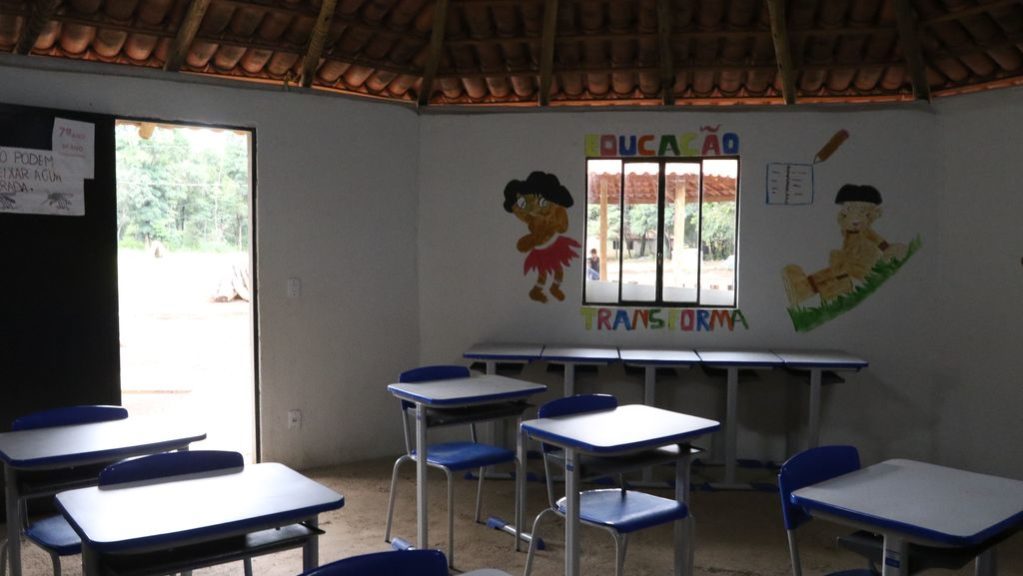
Sanitary exclusion still defines daily life at many rural schools in Brazil, especially in the North Region and on indigenous lands, where even the basics are lacking: drinking water and toilets.
A new study, published in the scientific journal Cadernos de Saúde Pública, lays bare the weight of this inequality. The research conducted by the Federal University of Minas Gerais (UFMG) and the Pontifical Catholic University of Minas Gerais (PUC Minas) shows that, among the rural public elementary schools analyzed, small schools with up to 10 students and those located on indigenous lands suffer the most from a lack of water supply and sewage systems—infrastructure essential for access to sanitation.
The study examined data from 2011 to 2023 from the Basic Education School Census, coordinated by the Anísio Teixeira National Institute for Educational Studies and Research (Inep).
According to the survey, more than 22,000 rural public elementary schools closed during this period. Of the more than 56,000 schools in 2011, just over 34,000 remained open by 2011. “Many of these schools were precisely the most vulnerable. When they cease to exist, the problem diminishes in the statistics, but not necessarily in the children’s lives. In addition, many students come to depend on school transportation over long distances, which is not always available on a regular basis,” explains Lívia Pita Corrêa, the study’s lead author.
The mapping shows that northern Brazil remains the most affected. According to 2023 data, 27.5% of this region lacked bathrooms—with Pará standing out negatively. In the state, the distance between cities, isolation, and difficult transportation—often by river—make installing water and sewage networks more expensive.
Meanwhile, rural public elementary schools on indigenous lands performed worse than other rural public elementary schools. “In schools located on indigenous lands, the situation is even more critical. The greater lack of bathrooms and sanitation reflects a historical process of exclusion in access to basic services. In practice, this directly affects students’ health, increasing the risk of disease, and also compromises their retention in school,” the researcher notes.
This situation exacerbates inequalities and particularly disadvantages girls. Without access to basic services, health and dignity are compromised, and many students drop out of school. “Without adequate infrastructure, many stop attending school during their menstrual period and, in some cases, end up dropping out altogether. This shows that access to water, sanitation, and hygiene in schools is not just a matter of infrastructure, but also of equity,” says Corrêa.
The authors argue that the public funding model itself exacerbates the situation. The Direct Money for Schools Program (PDDE) allocates less funding to schools with few students—precisely those that need it most. To effectively guarantee the right to education and health for all children, the researchers advocate strengthening fixed funding for rural schools, expanding technical support, and accounting for geographic isolation when distributing resources.
This material was originally published by Agência Bori.