



Successful initiatives in Maricá and Niterói have inspired cash transfer policies, but simulations show that most Brazilian municipalities would not have the financial capacity to replicate them using only their own resources.
The municipal cash transfer programs implemented in Maricá and Niterói, in the state of Rio de Janeiro, have become models because they combine poverty reduction, the strengthening of the local economy, and the use of social currencies. But to what extent could these models be replicated in other Brazilian municipalities?
This is the question explored in the article “Is it possible to make municipal basic income programs universal in Brazil? An estimate with municipal finance data”, published in Cadernos de Saúde Pública. Using data from the Cadastro Único (Single Registry) and public finance data from 5,570 Brazilian municipalities, the authors estimated the cost of implementing programs modeled after the Maricá Basic Citizenship Income (RBC-Maricá) and the Niterói Araribóia Social Currency (MSA-Niterói). The study did not assess the impacts of these programs, only the cost of replicating them in other municipalities. The results indicate that, although these initiatives serve as models in their local contexts, their expansion nationwide would face significant fiscal constraints.
According to the researchers, the main conclusion is that the universal implementation of these programs, financed exclusively by municipalities, is unlikely. This is because Maricá and Niterói have very specific economic conditions, characterized by high tax revenues and income from oil royalties—a reality far removed from that of most Brazilian cities.
“The deep regional inequalities and the high fiscal cost for most municipalities suggest that the expansion of basic income programs in Brazil, based exclusively on municipal funds, is unlikely,” the authors conclude. They add that it will be necessary to discuss “other forms of financing, possibly with substantial support from the federal government.”
The researchers note, however, that the prospects for implementing a federal basic income program in a context of budgetary constraints “do not seem promising,” since the federal government already funds other income transfer programs as well as health and education policies. For this reason, they argue that the discussion on expanding basic income in Brazil cannot be separated from the debate on tax justice and income redistribution. The authors also caution that, from a progressive perspective, basic income should serve as a complement to universal public services and other social guarantees, rather than as a substitute for them.
Two reference models
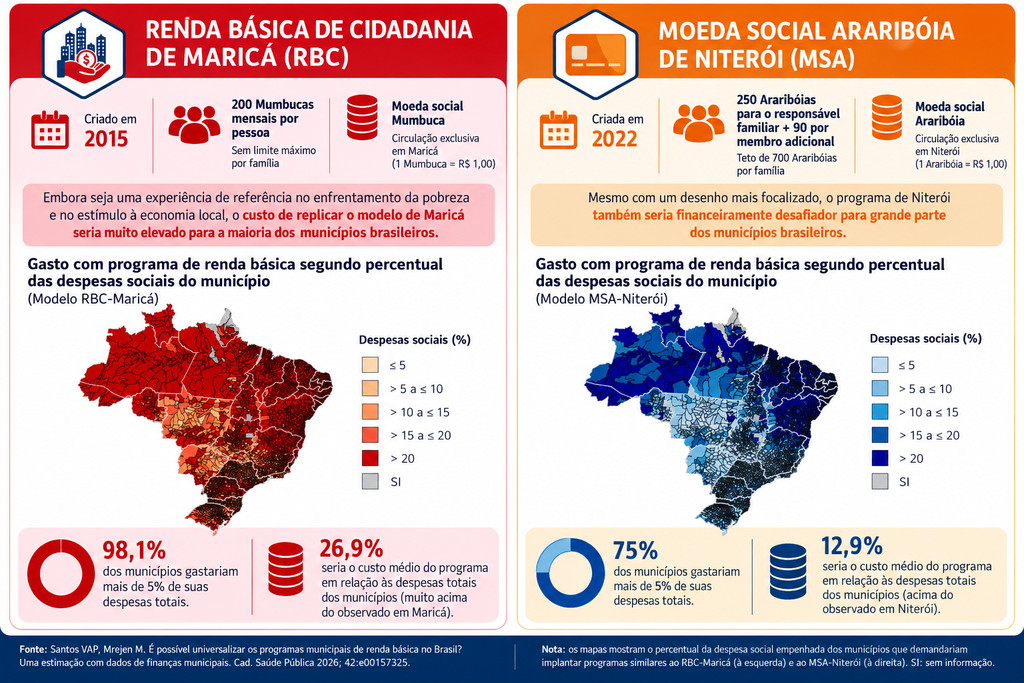
Created in 2015, the Maricá Basic Citizenship Income program provided, in 2023—the study’s reference year—200 Mumbucas per month to each member of eligible households, with no maximum limit per household. The program uses the Mumbuca social currency, which circulates only within the municipality and has a one-to-one parity with the real. The Araribóia Social Currency, on the other hand, implemented in Niterói in 2022, is intended for socially vulnerable families and, in 2023, provides a benefit of 250 Araribóias to the head of the household, plus 90 units per additional family member, capped at 700 Araribóias per family.
In addition to providing cash transfers, both programs use social currencies that circulate only within the municipalities. As the authors point out, this design may limit beneficiaries’ ability to consume outside the municipality, but there is evidence of its positive effect on municipal finances by stimulating the local economy.
High cost for most cities
When simulating the adoption of these programs by Brazilian municipalities, the researchers identified significant differences between the models and the cities’ financial realities.
If all of them were to implement a program similar to the RBC-Maricá, the average cost would amount to 26.9% of total municipal expenditures and 38.7% of social expenditures—proportions much higher than those observed in Maricá. In the case of the model inspired by Niterói, the average percentages would be 12.9% of total expenditures and 15.2% of social expenditures.
The results also show that 98.1% of municipalities would spend more than 5% of their total expenditures to maintain a program similar to Maricá’s, while 75% would exceed that same threshold if they adopted the Niterói model.
Regional inequalities exacerbate the challenge
Another aspect highlighted by the study is the significant regional inequality in the ability to fund municipal basic income programs. Under the model inspired by Niterói, most municipalities in the South (61.7%) would be able to implement such a program by spending less than 5% of their total expenditures—a fiscal effort comparable to that of Niterói —a proportion that drops to about three out of every ten municipalities in the Midwest (29.8%) and the Southeast (29.6%), levels that are similar to one another. In the model inspired by Maricá, however, the situation is more restrictive: no municipality in the North, Northeast, or Midwest would be able to stay within the 5% limit of total expenditures. Even so, even in the most affluent regions, feasibility is concentrated in the municipalities with the highest incomes.
The authors note that this scenario could exacerbate existing inequalities, since municipalities with greater revenue-raising capacity would tend to offer more robust benefits than those with fewer available resources.
Coverage or benefit amount?
The study also simulated two scenarios in which all municipalities would allocate the same fiscal resources to basic income as Maricá and Niterói did in 2023. In the first scenario, municipalities would dedicate the same share of social spending to the program as Maricá (11.2%), prioritizing coverage, with eligibility limited to families with incomes of up to three minimum wages. In the second, they would allocate the share committed by Niterói (9.2%), prioritizing targeting, with eligibility restricted to families living in poverty or extreme poverty. In both scenarios, a significant dilemma emerged: the greater the coverage of the served population, the lower the amount received by each beneficiary tends to be—and this trade-off varies considerably across the country’s regions.
According to the authors, there is no single answer as to which design is more appropriate, as this choice depends on the objectives of public policy: whether to expand the benefit’s reach or to concentrate resources on the most vulnerable groups.
As the researchers summarize, “there is a trade-off between coverage and the value of transfers per beneficiary,” in addition to significant regional differences in the amount each municipality would be able to pay while maintaining the same level of fiscal effort.
Limitations of the study
The authors point out some limitations of the study. The calculation for the MSA-Niterói may have overestimated the average value of transfers in municipalities with few vulnerable families but with many family members, since the method assumes a uniform distribution of vulnerable individuals among families. The administrative costs of implementing and managing the programs were also not considered; the estimate covers only the costs of direct transfers. Finally, the study did not consider differences in the cost of living across municipalities, which may affect the purchasing power of the benefit in each scenario.