


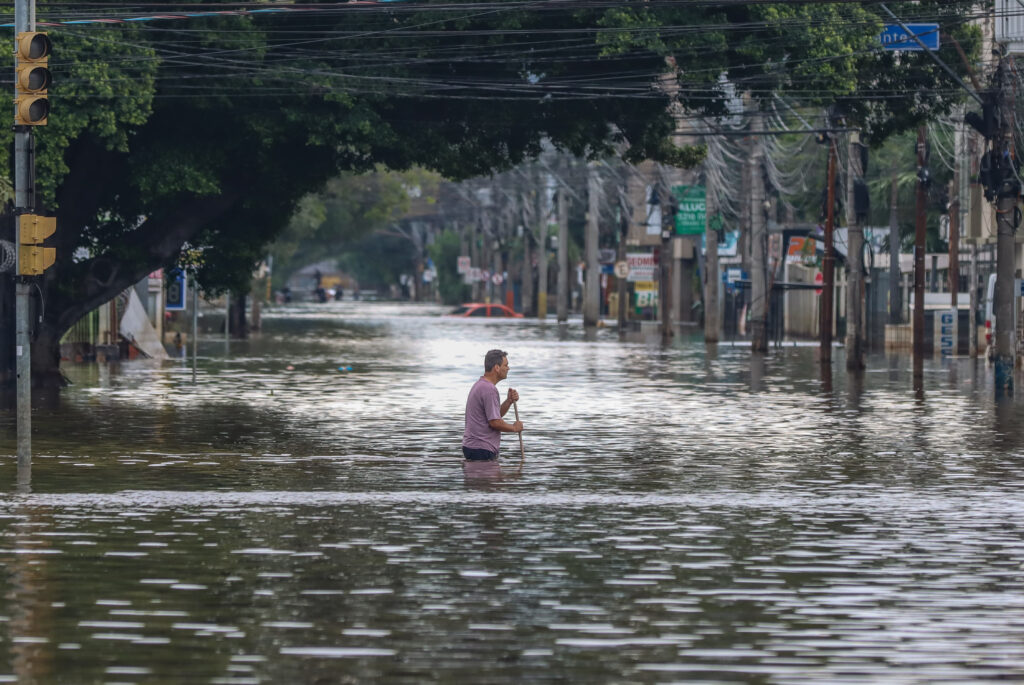
In this interview, Roger Ferreira Gomes discusses the main results of the study “Floods in Rio Grande do Sul, Brazil, in 2024, and their effects on the epidemiology of leptospirosis,” the challenges for surveillance and diagnosis during disasters, and the need to incorporate leptospirosis more effectively into public health and climate adaptation agendas.
1. The data show a 7.6-fold increase in the number of cases and four times more deaths in 2024 compared to 2023. What do these numbers reveal about the institutional unpreparedness to deal with an event of such magnitude?
The numbers reveal, above all, the enormous vulnerability of populations and health systems in the face of extreme weather events of this magnitude. The 7.6-fold increase in cases and the five-fold increase in deaths from leptospirosis compared to 2023 demonstrates how an extreme weather event can quickly turn into a public health crisis.
I do not believe it is possible to attribute this result exclusively to institutional unpreparedness, because we are talking about an unprecedented disaster in the recent history of Rio Grande do Sul. However, the data show that there are still important challenges in preparing for events of this nature, especially in areas such as sanitation, housing, epidemiological surveillance, risk communication, and the response capacity of health services.
The 2024 floods highlighted that leptospirosis should not be seen only as an infectious disease, but also as a marker of social inequalities and environmental vulnerability. The most affected municipalities were concentrated precisely in the areas most exposed to flooding, reinforcing the importance of public policies capable of reducing risks before disasters occur.
More than identifying specific shortcomings, the study’s results offer an opportunity to reflect on the need to strengthen the resilience of health systems, urban infrastructure, and social protection mechanisms, making them better prepared to respond to high-impact situations such as the one observed in 2024.
2. The article describes leptospirosis as an “invisible” disease for managers and decision-makers. Why does leptospirosis remain neglected in Brazil, even though it is endemic and has a lethality rate higher than the global average?
Leptospirosis remains neglected because, despite its significant impact on morbidity and mortality, it predominantly affects populations in situations of social vulnerability and usually occurs in contexts of urban precariousness, inadequate sanitation, and occupational or environmental exposure to risks. Historically, diseases associated with poverty tend to receive less attention and investment than other health problems with greater social and political visibility.
In addition, leptospirosis presents significant diagnostic challenges. The initial symptoms can be similar to those of several other febrile illnesses, which makes early recognition of cases difficult and can contribute to underreporting. As a consequence, the true magnitude of the problem is often not fully perceived by managers and society.
Another important aspect is that the visibility of leptospirosis tends to be episodic, increasing during outbreaks and emergencies, but decreasing rapidly after these events. Despite remaining endemic in many Brazilian regions, the disease frequently returns to a state of relative invisibility. This creates a cycle in which attention increases during emergencies, but structural investments in prevention, sanitation, surveillance, and health education are not always maintained in the long term.
Our study reinforces that leptospirosis remains in a paradoxical position: it is a disease known for more than a century, but still receives less scientific, political, and financial attention than its epidemiological relevance warrants. While other health emergencies rapidly mobilize resources and visibility, leptospirosis often remains restricted to surveillance and assistance services, which hinders sustained progress in prevention, diagnosis, and control.
3. The manuscript mentions that only 26.6% of sewage in Rio Grande do Sul receives adequate treatment and that failures in dikes and galleries were evident in 2024. What structural investments are priorities to reduce the vulnerability of Rio Grande do Sul to future events?
The 2024 floods highlighted that the vulnerability of Rio Grande do Sul depends not only on the intensity of extreme events, but also on the capacity of urban infrastructure and public services to withstand and respond to these events. Therefore, priority investments need to go beyond rebuilding what was lost.
One of the main challenges is expanding sewage collection and treatment coverage, since environmental contamination plays a central role in the transmission of leptospirosis and other diseases associated with floods. Similarly, investments in urban drainage, proper stormwater management, and modernization of flood protection systems, including dikes, pumping stations, and drainage galleries, are fundamental to reducing the impact of future events.
It is also important to strengthen hydrometeorological monitoring and early warning systems, allowing managers and communities to prepare further in advance. In the field of health, it is essential to expand the capacity for epidemiological surveillance, diagnosis and rapid response during emergency situations.
Investments in sanitation, urban drainage, flood protection, hydrometeorological monitoring and strengthening health services not only reduce the impacts of future disasters, but also generate permanent benefits to the quality of life of the population.
4. 76% of cases occurred among people who self-identified as white, reflecting the demographic composition of Rio Grande do Sul. The article warns that this cannot be extrapolated to the Brazilian context. What precautions are necessary when using this data to support national public policies?
The main precaution is to understand that the data observed in Rio Grande do Sul reflect the demographic, social, and territorial characteristics of the state and should not be interpreted in isolation or automatically generalized to the entire country. The fact that 76% of cases occurred among people who self-identified as white is directly related to the population composition of Rio Grande do Sul, which differs significantly from that observed in many other regions of Brazil.
When formulating national public policies, it is essential to consider local and regional specificities. In epidemiology, the risk of illness is not associated with race or color per se, but with social, environmental, and health access conditions that determine different levels of exposure and vulnerability. These factors can be distributed differently among population groups depending on the context analyzed.
Therefore, the data from Rio Grande do Sul should be interpreted as a snapshot of an event that occurred in a specific population. In other regions of Brazil, where the demographic composition and social inequalities present different characteristics, the profile of the most affected groups may be distinct.
The main lesson for public policies is not to focus on a specific racial group, but to identify which populations are most exposed and vulnerable in each territory. Effective disaster prevention and response strategies need to be guided by local realities, recognizing that the social determinants of health vary between states, municipalities, and communities.
5. In 2023, only 12.8% of cases were confirmed by clinical-epidemiological criteria; in 2024, this number jumped to 49.5%. What does this change say about the diagnostic limitations in disaster situations, and what risks does it pose to the quality of epidemiological data?
The significant increase in confirmations by clinical-epidemiological criteria in 2024 reflects the challenges faced by health and surveillance systems during a large-scale disaster. In scenarios such as that observed in Rio Grande do Sul, there is an abrupt increase in healthcare demand, logistical difficulties in collecting and processing samples, service interruptions, and the need for rapid clinical and epidemiological decision-making. In addition, warnings about the risk of leptospirosis associated with contact with floodwaters may have increased the degree of clinical suspicion in compatible cases.
Under these circumstances, the clinical-epidemiological criterion becomes a fundamental tool to ensure the timely identification of cases and allow for rapid surveillance and care responses. In a context of widespread population exposure to floodwaters and a significant increase in disease circulation, waiting exclusively for laboratory confirmation could delay important clinical management and public health measures.
In addition, during the floods, several municipalities faced severe logistical difficulties. In some locations, the isolation resulting from the interruption of highways and other transportation routes made it difficult or even impossible to send samples to reference laboratories. In these contexts, the combination of clearly established epidemiological exposure, such as contact with floodwaters, and a clinical picture compatible with leptospirosis represented an essential alternative for confirming cases and maintaining epidemiological surveillance during the emergency.
On the other hand, this change also highlights limitations to be considered in the interpretation of epidemiological data. The greater reliance on clinical-epidemiological criteria may increase the possibility of misclassifying some cases, especially since leptospirosis shares clinical manifestations with several other febrile illnesses. This can affect estimates of incidence, lethality, and case distribution.
In emergency situations, a delicate balance exists between diagnostic accuracy and speed of response. The 2024 experience showed that clinical-epidemiological criteria were fundamental to maintaining active surveillance even when usual laboratory workflows were compromised, allowing the magnitude of the event to be monitored in real time.
6. The manuscript concludes by requesting that leptospirosis be incorporated more explicitly into national and international public health agendas. What concrete changes in policies, funding, and surveillance would be necessary?
The more explicit incorporation of leptospirosis into public health agendas requires, first and foremost, the recognition that the disease represents a challenge that goes beyond the health sector, involving issues of sanitation, urban planning, epidemiological surveillance, and preparedness for extreme events. Recent events have demonstrated that leptospirosis can cease to be a localized problem and assume the dimensions of a public health emergency when associated with extreme climate disasters.
In the field of public policy, it is essential to strengthen the integration between the health, sanitation, environment, civil defense, and urban planning sectors. The prevention of leptospirosis depends both on surveillance and assistance actions and on structural investments capable of reducing the population’s exposure to contaminated environments.
Regarding financing, it is necessary to increase resources allocated to the surveillance of climate-related diseases, the expansion of basic sanitation, the strengthening of laboratory capacity, and the preparation of health systems to respond rapidly to emergency situations. It is also important to encourage scientific research on leptospirosis, a disease that, despite its epidemiological relevance, still receives less attention and investment than other infectious diseases.
In the context of surveillance, strengthening monitoring and early warning systems is essential. The integration of epidemiological, environmental, and meteorological data can allow for faster identification of risk areas and the early adoption of prevention and control measures. In addition, it is necessary to invest in the continuous training of surveillance and assistance teams for the timely recognition of cases, especially in disaster scenarios.
The experience of the 2024 floods suggests that leptospirosis should be incorporated more explicitly into climate adaptation strategies. In this context, it can be understood as a sentinel disease of climate change, capable of revealing how extreme events, social inequalities, and structural fragilities combine to produce impacts on the health of the population.
Article Title: Floods in Rio Grande do Sul, Brazil, in 2024, and their effects on the epidemiology of leptospirosis
Authors: Bernardo Madeira Diefenthaeler, Alexia Antunes Deluca, Jéssica Manami Seki, Marco Antônio Tavares Duarte, Vinícius da Silva Gregory, Sofia Giacomet Borges, Roger Ferreira Gomes, and Maria Helena Rigatto
Interview: Roger Ferreira Gomes
How to cite the manuscript: Diefenthaeler BM, Deluca AA, Seki JM, Duarte MAT, Gregory VS, Borges SG, Gomes RF, Rigatto MH. Floods in Rio Grande do Sul, Brazil, in 2024, and their effects on the epidemiology of leptospirosis. Cadernos de Saúde Pública 2026; 42(1):e00111125 doi: 10.1590/0102-311XPT111125